Liquid, creamy, or solid honey?
Honey, a living product with a thousand textures
Not all honeys are the same. Depending on their floral origin, temperature, or how they are processed, they can have different textures: liquid, creamy, or solid.
This diversity does not reflect a difference in quality, but rather the living nature of honey. Each form has its own characteristics, uses, and fans. So how can these variations be explained, and how can you choose the one that suits you best?
At Ruche & Flore, we help you better understand the secrets of these three natural textures.
Liquid honey: the natural form immediately after harvesting
A fluid, golden honey
When it leaves the hive, all honey is liquid. The nectar that bees collect naturally contains a high proportion of water (around 17 to 20%). After extraction and maturation, honey remains fluid for a certain period of time.
This liquid honey is appreciated for its transparency, shine, and ease of use: it pours easily, dissolves quickly in drinks, and is perfect for sweetening tea, yogurt, or salad dressing.
A texture that evolves over time
Most honeys eventually crystallize naturally after a few weeks or months. This phenomenon depends on their composition: honeys rich in glucose (such as rapeseed or dandelion honey) crystallize quickly, while those rich in fructose (such as acacia or chestnut honey) remain liquid for longer.
This is not a sign of deterioration, but a natural and healthy process that proves that the honey has not been heated to high temperatures.
When to choose liquid honey
- To sweeten hot drinks (tea, herbal tea, milk).
- In baking, when a fluid texture makes measuring easier.
- For drizzling over fruit, pancakes, or fresh cheeses.
Liquid honey is also ideal for appreciating the color and transparency unique to each variety.
Creamy honey: the perfect balance between sweetness and convenience
A smooth texture that is easy to spread
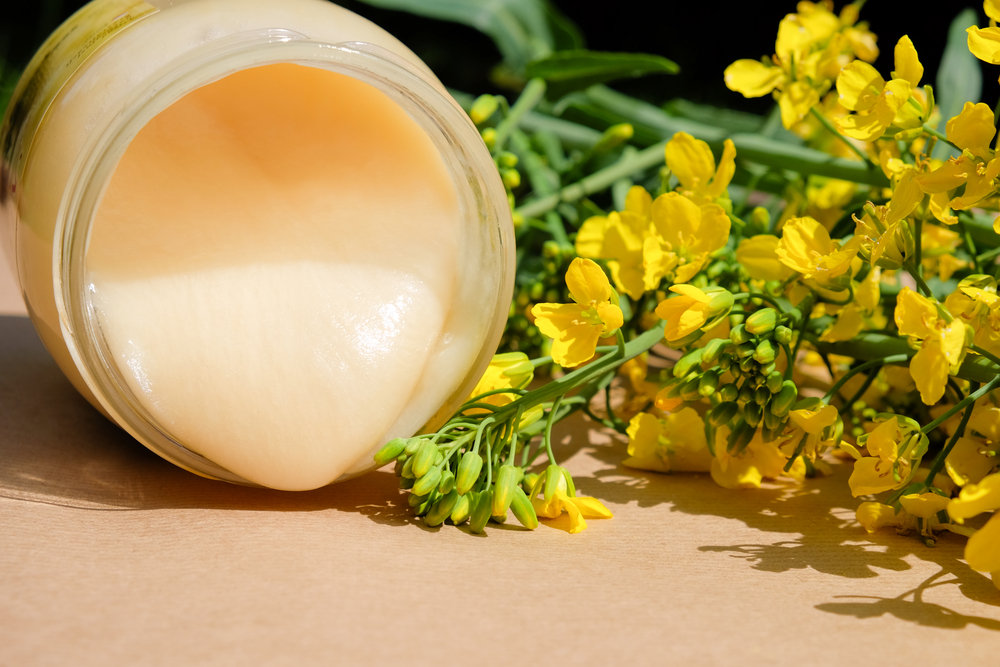
Creamy honey, also known as processed honey, is honey whose natural crystallization has been controlled by stirring. This artisanal process involves seeding the honey with very fine crystals, then stirring it slowly and regularly until a homogeneous texture is achieved.
The result? A sweet, non-runny honey with a smooth, velvety texture that spreads beautifully without dripping.
100% natural honey
Contrary to popular belief, creamy honey is not an industrial product. It contains no additives, no fat, and no added sugar. It is still pure honey, simply cold-processed to control its crystallization.
This artisanal process preserves all the natural qualities of honey, without altering its flavors or benefits.
When to choose creamy honey
- For breakfast: it stays on the toast without running.
- For children: its soft texture is easier to handle.
- For those who enjoy honey that is neither runny nor hard.
At Ruche & Flore, many of our Swiss mountain and flower honeys are available in a creamy form, the result of patient and entirely natural processing.
Solid honey: honey in its raw state
Natural crystallization
Over time and under the effect of cold temperatures, honey naturally solidifies. This phenomenon, called crystallization, depends on the proportion of glucose and fructose.
Rapeseed, sunflower, and dandelion honeys crystallize very quickly, sometimes within a few days of harvesting, while others, such as acacia and fir honey, can remain liquid for several years.
A guarantee of naturalness
Solid honey is not "old" honey: it is authentic, unheated honey. Some beekeepers prefer to leave it as it is, because this texture proves that it has not undergone any processing or pasteurization.
In this form, it retains all its natural properties and can be eaten with a spoon or melted into a warm drink.
When to choose solid honey
- To be eaten with a spoon, plain.
- For cooking or baking: it is easy to weigh and melts quickly when heated.
- For lovers of rustic honeys with a raw and authentic texture.
If you want to restore a fluid texture, simply place the jar in a double boiler at a low temperature (max. 40°C) for a few minutes. The honey will become liquid again without losing its natural qualities.
Liquid, creamy, or solid: the taste remains the same
Contrary to what one might think, the texture of honey does not influence its taste, but only the perception of aromas in the mouth.
Liquid honey releases its sweet and floral notes more quickly, while creamy or solid honey offers a slower, more mellow tasting experience. The choice therefore depends above all on your preferences and how you use it on a daily basis.
Temperature, a key factor
The texture of honey also varies depending on the ambient temperature.
- Above 25°C, it generally remains fluid.
- Between 10 and 20°C, it becomes creamier.
- Below 10°C, it tends to freeze.
This is why the same honey can change texture depending on the season. It is a completely natural phenomenon that requires no processing or preservatives.
How to store honey
Regardless of its state (liquid, creamy, or solid), honey can be stored for a very long time if kept in the right conditions:
- At room temperature (ideally between 15 and 20°C)
- Protected from direct light and moisture
- In a tightly sealed jar, to prevent it from absorbing outside odors
Honey that is stored properly will retain its taste, color, and texture for several years.
Honey according to Ruche & Flore: purity and Swiss expertise
At Ruche & Flore, we offer a collection of Swiss honeys from protected areas and a variety of flowers: Vaud fir honey, rhododendron honey, chestnut honey, spring blossom honey…
Each honey is harvested with respect for the bees and their environment, without excessive heating or intensive filtration. This approach guarantees lively honeys with natural textures that evolve harmoniously over time.
Whether liquid, creamy, or solid, your Ruche & Flore honey reflects its terroir, season, and authentic beekeeping expertise.
In summary
| Texture of honey | Appearance | Special features | Ideal use |
|---|---|---|---|
| Liquid | Smooth and shiny | Freshly extracted honey, easy to pour | Teas, herbal teas, pastries |
| Creamy | Creamy and smooth | Crystallization controlled by stirring | Toast, breakfast |
| Solid | Compact, grainy | Natural crystallization, raw honey | Tasting with a spoon, cooking |
Conclusion
Whether liquid, creamy, or solid, honey remains above all a living product that is constantly evolving. Its texture is not a criterion of quality, but a reflection of its natural richness.
Whether you prefer runny honey to sweeten your drinks, creamy honey for your toast, or solid honey for its rustic flavor, each reveals a different facet of the same treasure: the patient work of bees and the purity of Swiss nature.
At Ruche & Flore, we celebrate all these textures, because each one tells a story—the story of authentic honey, harvested with care and respect.


