Which royal jelly to buy?
Which royal jelly to buy?
Royal jelly is one of those more or less well-known treasures, like caviar or an exceptional wine, with which it's easier to make a mistake and end up with a more or less successful imitation than to find a product with all the guarantees ofa genuine royal jelly, carrying all its properties.
There are a number of key points to bear in mind
Origin, shape, packaging, price, label
According to figures from the leading French royal jelly producers' association, the combined annual production of all its members barely covers 2% of consumption in France and Switzerland.
This figure gives an idea of how difficult it is to find authentic, fresh royal jelly... 1 chance in 50 in reality.
Let's take a look at how to make the most of this opportunity.
1/ Origin :
Like many products, most of the royal jelly available in Switzerland and France comes from China. That's over 95% of the market, and whatever its form, packaging, price or label, you're more than 9 out of 10 likely to buy Chinese royal jelly.
Indeed, the Chinese industry, urged on by its customers (including the overwhelming majority of European laboratories), has succeeded in setting up an organic sector (whose specifications are unknown to us), which, by some sleight of hand, has managed to obtain the Bio-FR or Bio-EU label on the packaging of its products containing royal jelly produced in China.
First lesson: give preference to your beekeeper, especially if he or she is a member of a certified royal jelly producers' association or distributor.
2/ Shape & packaging :
Authentic royal jelly has not been processed, frozen or freeze-dried; it must be fresh and in its jellied state.
Avoid at all costs the so-called exceptional royal jelly offered in syringes, capsules or ampoules, as these packaging operations are incompatible with quality preservation. These types of packaging allow laboratories to mix royal jelly (of remote origin) with other ingredients such as ginseng, vitamin C, etc.
Worse still, these operations involve the use of either frozen or freeze-dried royal jelly, and analyses have shown that little of this treasure's formidable properties remains.
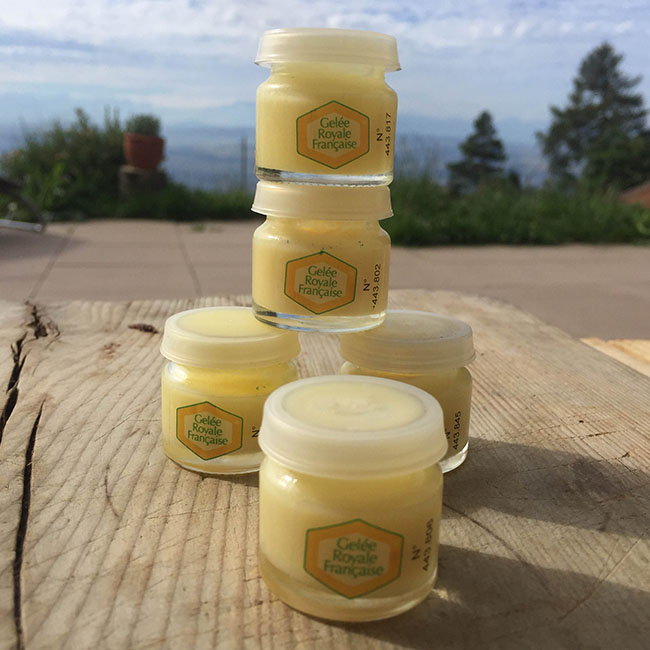
Instead, opt for fresh, pure royal jelly, delivered in a small glass jar protected by Sagex (or polystyrene) or cork, 2 products that keep royal jelly cool for up to 24 hours outside the fridge. Available in 10g or 25g cures.
3/ Price:
Like all exceptional products, royal jelly comes at a price, and that price is rather high.
If you're lucky enough to live far from a conurbation and have a royal jelly-producing beekeeper as a neighbor, you'll be one of the very few people who can have access to this caviar from the hive for around thirty francs / euros.
More reasonably, you'll find real, fresh royal jelly, packaged as it should be to guarantee that it stays in the cold chain, for an average price of between CHF 45 and 80 per 10g cure.
Beware of misleading presentation... you'll find laboratory packaging offering you 2,000 mg of royal jelly for the modest sum of CHF 69.00 in pharmacies. The more astute will convert the 2,000 mg into grams, i.e. 2 grams, and will soon realize that, in addition to inadequate packaging, their royal jelly will cost them the equivalent of almost CHF 350.00 per 10g, i.e. almost CHF 35,000.00 per kg, for a royal jelly that has travelled a long way ... and whose real properties are, alas, dubious.
4/ The label :
As we have already mentioned, the major laboratories offer products containing organic royal jelly, without the jelly being local or fresh... It's high time to put things into perspective and realize that these labels are no longer labels of trust, but are used by key players who use them to sell better rather than to produce better...
There is a label established in France whose specifications result in the production of royal jelly harvested in conditions that are almost wild for the bees, authentic royal jelly consumed all year round by the queen to feed and heal herself.
This label is known as "GRF" for "Gelée Royale Française". It was developed by the royal jelly specialists of the GPGR (Groupement des Producteurs de Gelée Royale).
This label prohibits beekeepers from collecting anything other than royal jelly during the royal jelly "campaign", it also prohibits any feeding other than with the own honey of the hives dedicated to royal jelly production during the said period and other obligations that make it the most demanding specification in the field ... and indeed the purest royal jelly available, harvested from a hive that lives in total autonomy.
For all these reasons, we can't help but remind you of the need to pay total attention to the royal jelly you buy. Another factor in favor of GRF-labeled royal jelly is that all jars are "batch-lotted" to guarantee total tracking of the origin of each jar of royal jelly produced under this label.
Since its creation, Ruche et Flore has offered you only fresh royal jelly with the GRF label, because we are members of this union and have access to all our fellow producers if necessary.


